Mexico, Guatemala, Belize, Honduras
QUINTESSENCE
Insights into signature aspects of the world’s most spectacular places
Maya Cosmology & SymbolsThe Ceremonial Serpent Bar
By David Raezer


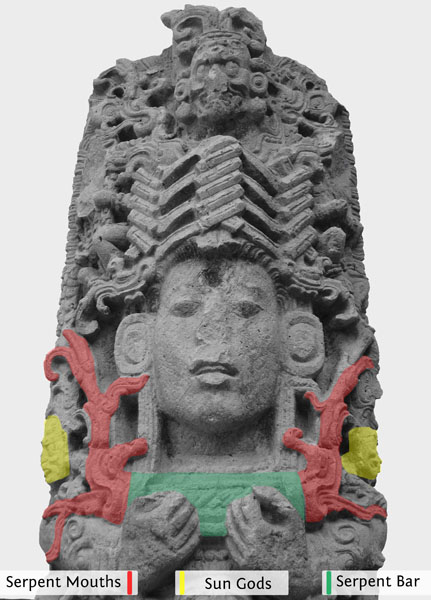
Ceremonial bars — also known as serpent bars — are a common symbol in the Maya world and often depicted being wielded by rulers on stelae. Such stelae were typically erected to commemorate a period-ending event (when the Maya base-20 long-count calendar zeroed out), commonly associated with change or rebirth.
The bar typically ends in two open serpent mouths, from which gods emerge; the serpent was the means of conveying a hallucinatory vision (the body of the serpent even paralleled the wisps of rising smoke from which burned blood offerings were delivered), the means by which the ruler communicated with parallel worlds and assured the survival of civilization. To make picking out the ceremonial bars easier, we have applied color highlights to the image at left.
More specifically, the bar is symbolic of the ruler’s pivotal dual-intermediary role, connecting the world of the living with (a) the world of the dead (in the underworld) and (b) the world of the gods (in the heavens). In Maya cosmology, such an intermediary role is typically filled by the “world tree,” or axis mundi: the tree – with its roots extended to the underworld and its uppermost branches high in the sky — bridges the the same gap among the earth, underworld and heavens. When holding the serpent bar, then, the ruler effectively assumes the role of world tree, with the bar representing its branches.
James Doyle, a curator at The Metropolitan Museum of Art, and art historian Steve Zucker explore the symbolism of the painted forms on a 7th-8th century CE (Classic period) Maya drinking vessel. Runtime: 7 min.
Approach Guides’ guidebooks — Maya Mexico and Maya Tikal and Copán (Guatemala & Honduras) — afford an expansive view of art and architecture in the Maya world.
Please note that some of the links above are affiliate links; as an Amazon Associate, Approach Guides makes a commission from qualifying purchases.

 Mosque of Córdoba, Spain | A Walk to the Mezquita’s Mihrab (Video)
