Siem Reap, Cambodia
QUINTESSENCE
Insights into signature aspects of the world’s most spectacular places
Cosmology Shapes Design of Angkor Wat Temple
By David Raezer


Moving from the temple’s entrance to the sanctuary at its center, the visitor undergoes a symbolic three-staged journey to salvation through enlightenment.
Each of the steps are laid out in the exhibit at right.
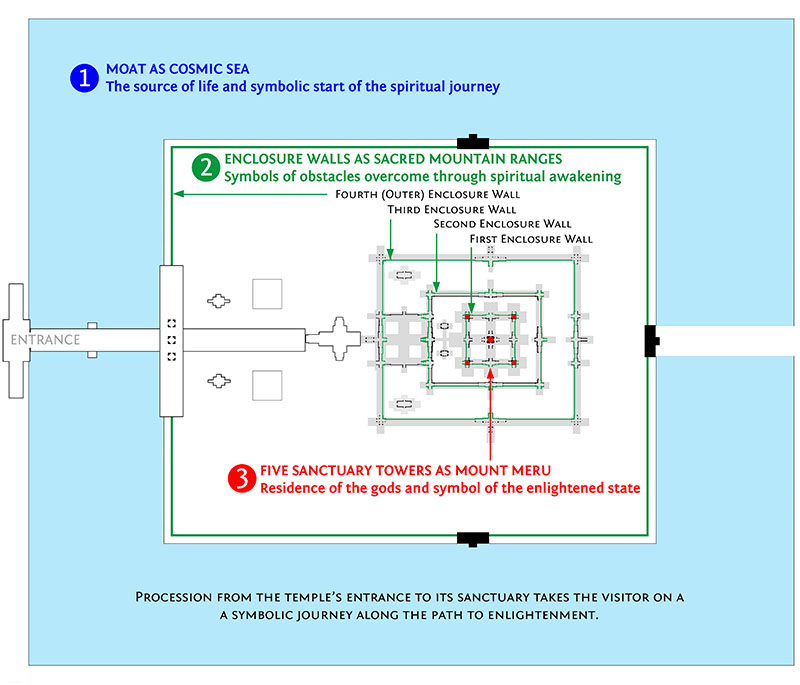
The outermost boundary of a Khmer temple was often surrounded by a moat, a body of water symbolic of the Cosmic Sea (blue highlights above). For Hindus, the Cosmic Sea is the source of creative energy and life, the starting point for the journey toward salvation.The temple visitor begins his journey by crossing the sea on causeways lined with serpents, beasts similarly intimately associated with both Hindu and Khmer myths of creation (we explore the serpent in detail in our guidebook to Angkor).
Continuing on his way to the center of the temple, the visitor passes through a series of massive enclosure walls; these walls recreate sacred mountain ranges, symbolic of obstacles that must be overcome on the path to enlightenment (green highlights in Fig. 1). Monumental tower gateways, called gopurams, grant the visitor passage through the walls, each successive one revealing a more sacred area, farther removed from the outside world.
The combination of concentric enclosure walls with large gateways was derived directly from South Indian Hindu architectural precedent. Enclosure walls make their first appearance very early in the Khmer building tradition — at the late 9th century pre-Angkor site of Roluos in the temples of Preah Ko, Bakong and Lolei — and are a constant feature in all subsequent temples.
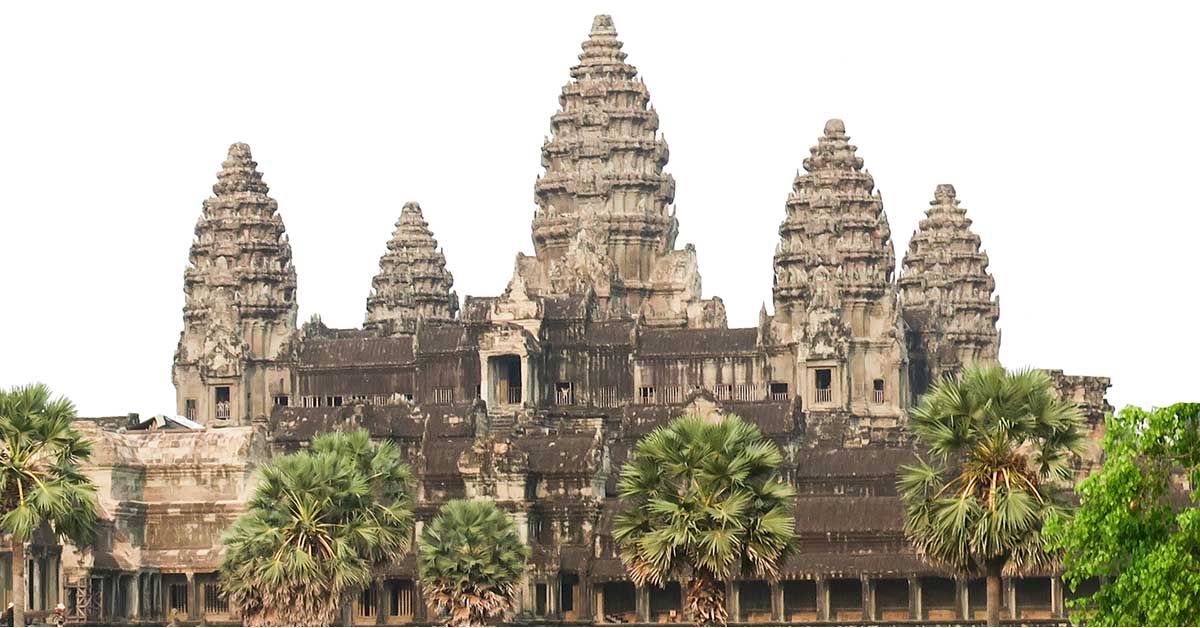
At the center of the temple stand sanctuaries with tower superstructures (red highlights above).
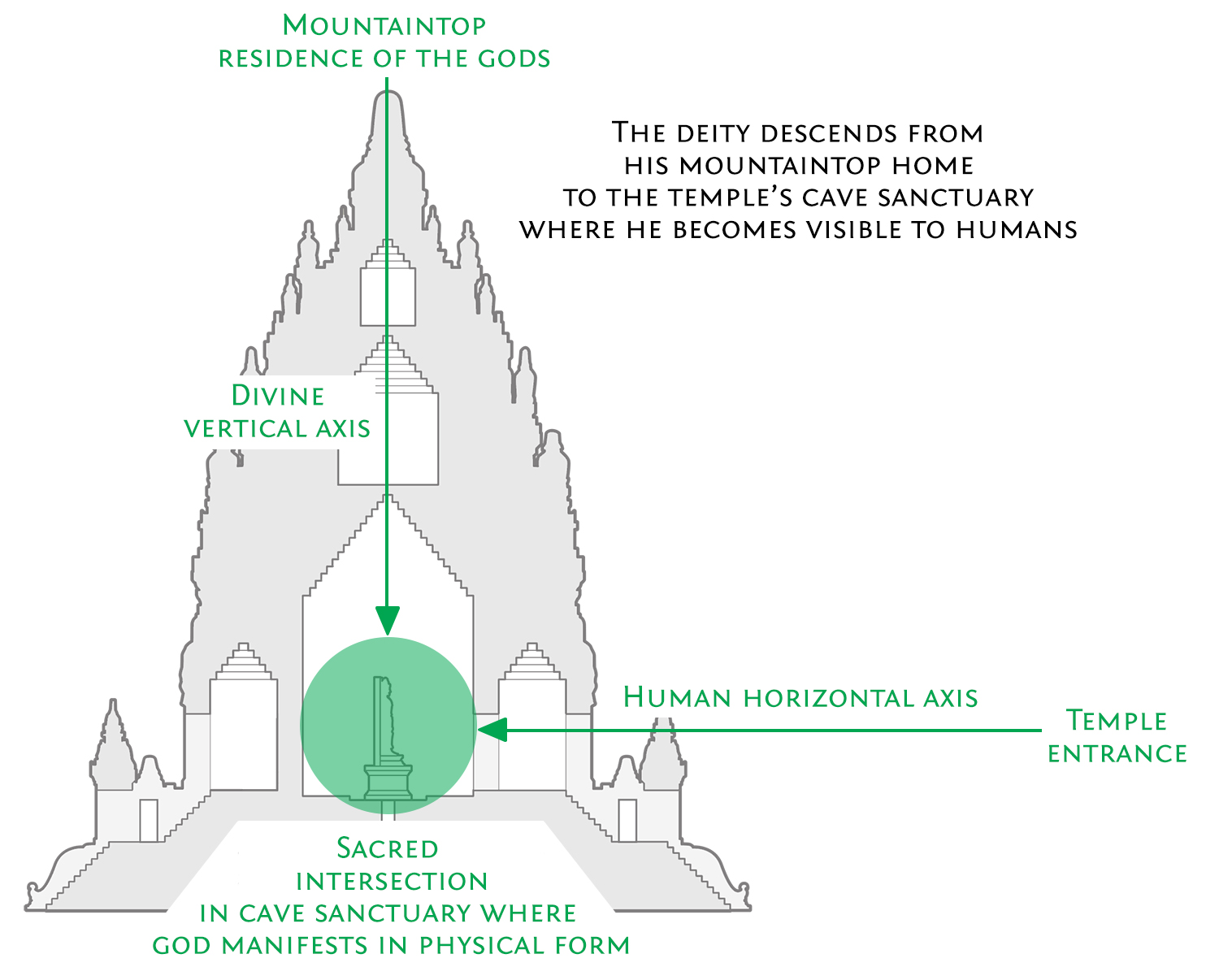
It is here, among the peaks of Mount Meru, that the visitor’s symbolic journey ends in nirvana: the pairs of opposites characteristic of worldly existence (e.g., good versus bad, right versus wrong) fuse into a single infinite everythingness beyond space and time.
The ancient capital of the Khmer Empire — that thrived for 500 years from 802-1327 — is one of the most magnificent sites in Southeast Asia. This recently updated and expanded Approach Guide serves as an ideal companion for travelers seeking a deeper understanding of Angkor’s art and architecture.
Please note that some of the links above are affiliate links; as an Amazon Associate, Approach Guides makes a commission from qualifying purchases.
 A Guide to Eating Thali in India