Crete, Greece

QUINTESSENCE

Insights into signature aspects of the world’s most spectacular places

World’s Oldest Olive Tree

By David Raezer

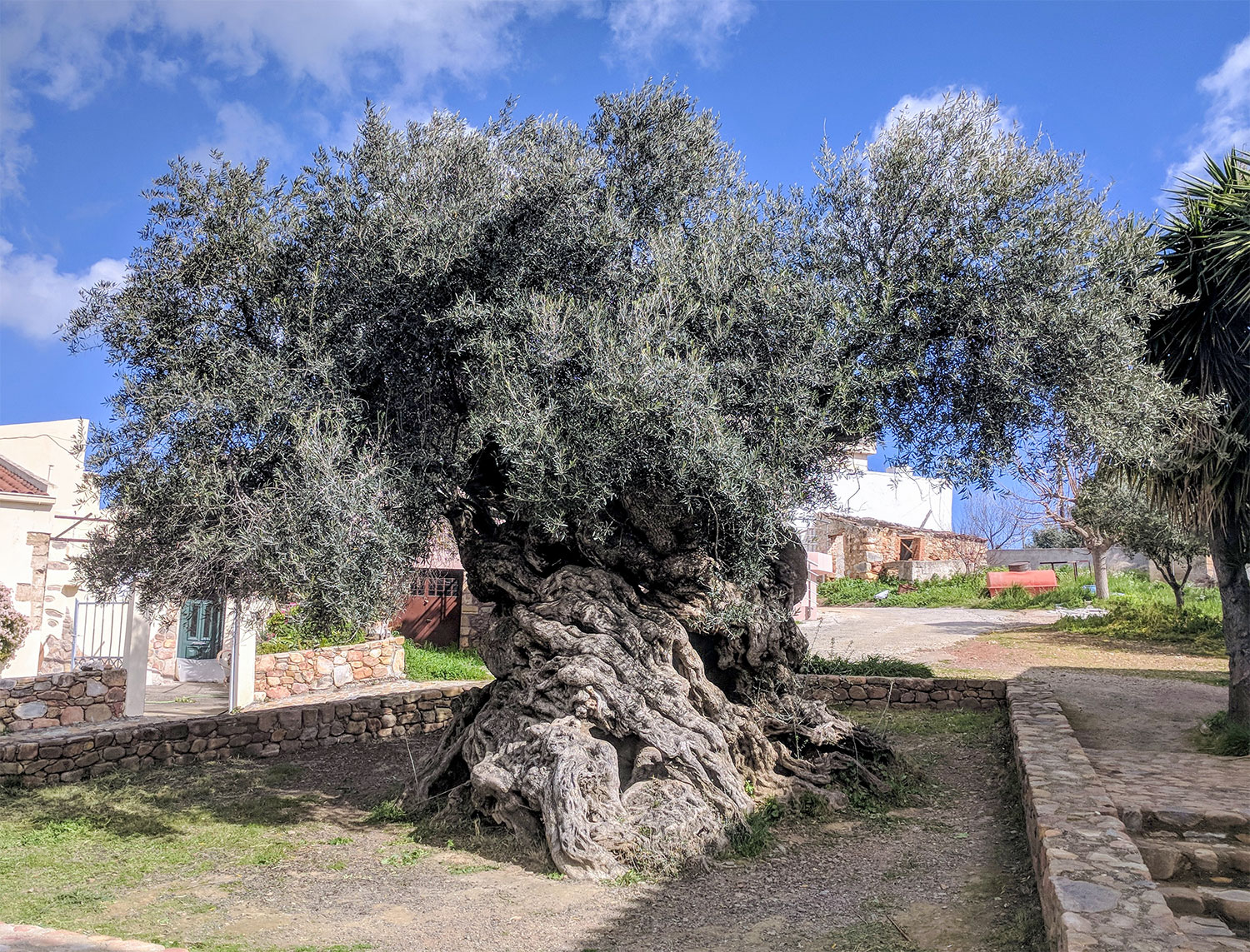
With age estimates ranging from 2000-4000 years, this tree—located in the small Cretan town of Ano Vouves—is generally accepted as the world’s oldest monumental olive tree. And the swirled, gnarled appearance of the tree (watch the video below to get an up-close perspective) evocatively communicates its incredible age, making for a special visit.
Quick Facts

  • Protected

    After having been donated by Panagiotis Karapatakis to the Municipality of Kolymvari, the tree—located in the small town of Ano Vouves, 30 km west of Chania in western Crete (see map)—was made a protected natural monument in 1997.

  • Once was wild

    The originally wild tree was later domesticated, having been grafted with the endemic Cretan olive cultivar Tsounati (aka Mastoeidis or Athinolia).

  • Still productive

    Despite its age, the tree still produces olives. Although Tsounati is typically consumed as a table olive, it also yields a high-quality strong-flavored oil with amber color, medium fruit, bitter-tinged notes of grass and herbs and a peppery finish. NB: Both Tsounati table olives and oils are on sale at the onsite boutique!

  • The age
    • The tree’s age cannot be determined with precision. Scientists cannot apply the conventional radioisotopes dating method, since due to the tree’s exceptional age, there is no remaining heartwood. (The video at right shows the tree’s empty center.)
    • Therefore, age estimates employ a less precise method, based on the size and perimeter of the trunk. Further, the tree’s possible linkage with two nearby cemeteries dating from the Geometric era (700 BCE) has informed estimates.
    • Age estimates range from 2,000-4,000 years. At the upper end of the estimate, this tree could have been harvested by the ancient Minoans!
    • The other tree that’s in the running for world’s oldest is Stara Maslina, located near Stari Bar in Montenegro.
  • Size & appearance
    • The trunk has a perimeter of 12.5 m (41 ft) and a diameter of 4.7 m (15.4 ft) at its widest point, according to a recent 3D modeling study.
    • The surface of the tree has a fantastic gnarled, swirling helical character.
    • There is a large inner cavity, formerly occupied by the tree’s heartwood.
  • Fun facts
    • Cuttings from the tree were made into olive wreaths (kotinos) for winners in the 2004 Athens Olympics and the 2008 Beijing Olympics.
    • Greece has, by far, the highest olive oil consumption in the world, exceeding 24 liters/person/year. This compares versus Spain and Italy, the next highest, at around 14 liters/person/year.
    • Olive trees cover roughly 1/4 of Crete’s surface area.

Take a Virtual Walk Around

Exploring...

Please note that some of the links above are affiliate links; as an Amazon Associate, Approach Guides makes a commission from qualifying purchases.