Konstanz, Germany

QUINTESSENCE

Insights into signature aspects of the world’s most spectacular places

Imperia Statue

By David Raezer

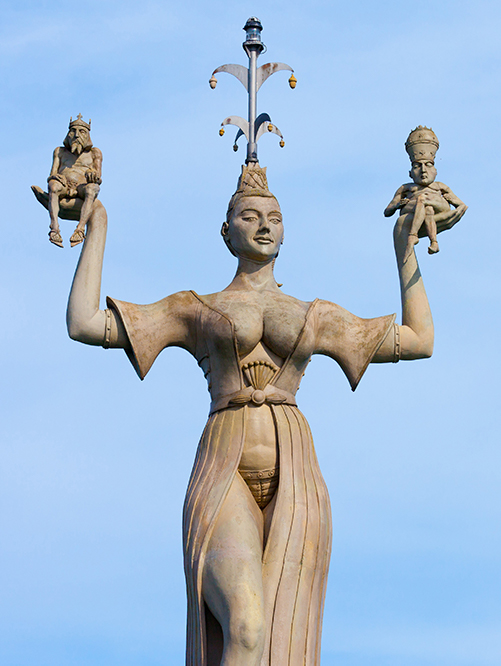
Located in the harbor of Konstanz, Germany, the rotating satirical statue — clandestinely erected by artist Peter Lenk in 1993, referencing the Council of Constance (1414-1418) — has become a symbol of the city.
Quick Facts

  • The history: Council of Constance

    The Council of Constance was a Catholic ecumenical council, held from 1414 to 1418 in Konstanz.

    • The council ended the Western Schism (1378-1417) — a split in the Catholic church that followed the restoration of the papacy to Rome (after nearly 70 years in Avignon), in which several men simultaneously claimed to be the true pope — by instating Pope Martin V.
    • Among other things, the council condemned Czech theologian Jan Hus as a heretic and had him burned at the stake. Hus is a central figure in the city’s story, as his ideas anticipated the Protestant Reformation by a full century. In fact, Martin Luther famously said: “Ich bin ein Hussite” (I am a Hussite).
  • The depiction
    • Imperia Cognati. The statue depicts a woman — perhaps Imperia Cognati (1486-1512), the famously beautiful Roman courtesan known for her relationship with the banker Agostino Chigi and others in the court of Pope Julius II — holding two men in her raised hands. Breasts exposed and smirking knowingly, she steps forward to expose her right leg and a prominent chastity belt. Atop her head is an oak tree, perhaps alluding to her connection with Pope Julius II, whose family (Della Rovere) coat of arms was an oak.
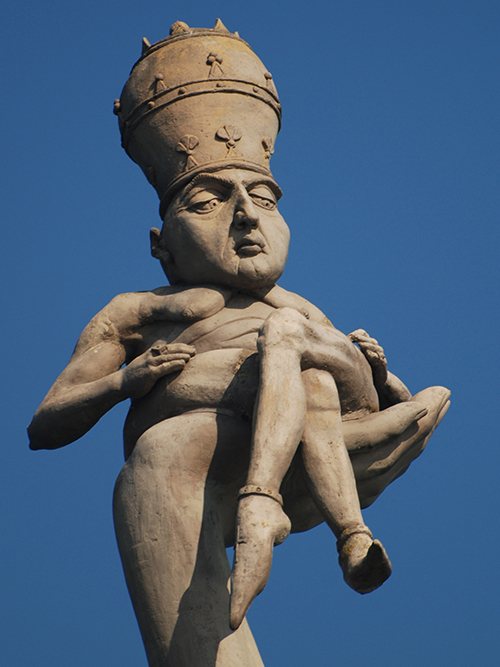
    • Pope Martin V. In her left hand (image below, at right), she holds the newly elected pope. Wearing the papal tiara, he sits, naked and legs crossed.
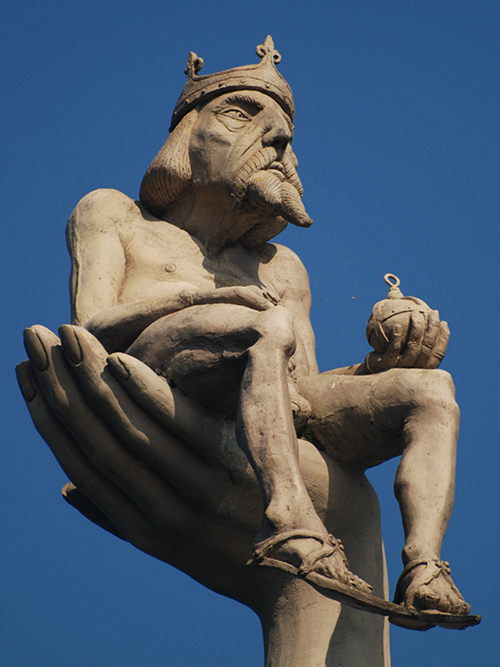
    • Emperor Sigismund. In her right hand (image below, at left), she holds Sigismund, who called the Council of Constance. Wearing the imperial crown, hit sits, similarly naked (barring sandals), holding the globus cruciger.
  • An interpretation
    • It is believed that the statue was inspired by Balzac’s La Belle Impéria, a satire in which the Catholic clergy and heads of state are seduced and manipulated by the courtesan at the Council of Constance.
    • Inspired by the story or not, the depiction is a masterful parody of the troubled state of the Catholic church and its partner in crime, the Holy Roman Empire. And, in this respect, it functions as a defense of Jan Hus, who died at their hands.
Exploring...
Exploring...

Please note that some of the links above are affiliate links; as an Amazon Associate, Approach Guides makes a commission from qualifying purchases.