QUINTESSENCE
Insights into signature aspects of the world’s most spectacular places
Guide to the Islamic Call to Prayer (Adhan)
By David Raezer


The call to prayer explained One of the most distinctive soundscapes associated with travel in the Islamic world is the call to prayer (adhan), recited five times each day. While in some placesthe call is subtle, in others is a central part of daily life and can be heard echoing throughout city streets.
No matter what the local language is, the call to prayer is always recited in Arabic, the language of the Quran. Here’s a rough translation:
God is the greatest (Allahu akbar); intoned four times.
I testify that there is no God but Allah (Ashhadu anna la ila ill Allah); intoned twice.
I testify that Mohammed is God’s Prophet (Ashhadu anna Muhammadan rasul Allah); intoned twice.
Come to prayer (Hayya alas salah); intoned twice.
Come to security/salvation (Hayya alal falah); intoned twice.
God is the greatest (Allahu akbar); intoned twice.
There is no God but Allah (La ilah ill Allah); intoned once.
Another line is sometimes added to the first prayer of the day (first light fajr):
Prayer is better than sleep (Assalatu khayrum minan naum); intoned twice.
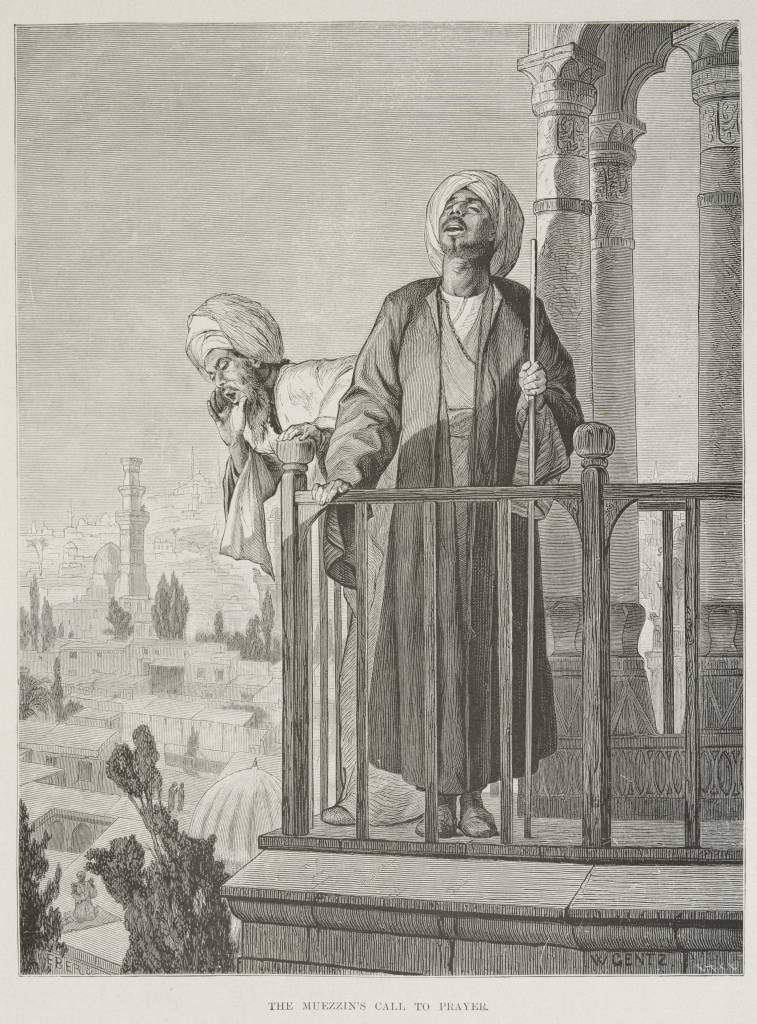
Historically, tower-like minarets — which most likely first came into use in the early- to mid-8th century under the Baghdad-based Abbasid caliphate (750-1258) — were used by the mosque’s muezzins as tall platforms from which to call believers to prayer and announce the central tenet of the Islamic faith to non-believers. Today, however, a muezzin (or imam) typically recites the call into a microphone in the main prayer hall, where it is then broadcast through loudspeakers installed on the minarets.
It is helpful to be familiar with the five daily prayer (salat) times:
Know the specific times
Due to their association with visual observations of the sun’s position in the sky, prayer times change (ever-so-slightly) on a daily basis. Visit this website to get up-to-date prayer times for the city that you are visiting: islamicfinder.org.
Knowing these times will help in planning your visit. While most mosques do not allow non-Muslims during prayer times, some do, typically smaller, more out-of-the-way mosques.
Please note that some of the links above are affiliate links; as an Amazon Associate, Approach Guides makes a commission from qualifying purchases.

 Off the Beaten Path in Sicily: Palermo’s Qanats